The Chain Reaction: Why Supply Chain Partners Have Become British Business's Most Neglected Reputation Asset

Where Reputation Actually Begins
The public narrative of corporate reputation tends to focus on what organisations say — their press releases, their executive statements, their social media presence. The more uncomfortable reality, as a succession of British corporate crises has demonstrated, is that reputation is increasingly determined by what organisations do not know about the partners operating in their name.
From fast fashion manufacturers to food supply networks, from logistics contractors to technology subcontractors, the supply chain has emerged as the most consequential and least managed dimension of British corporate reputation. The companies whose names appear on the high street, in the financial press, and in parliamentary debates are rarely the ones whose conduct triggers scrutiny. They are the ones whose names are associated with the conduct of others — others with whom, in many cases, they have communicated only through procurement contracts and compliance questionnaires.
This is the supplier silence: the absence of any meaningful, strategic communications relationship between British businesses and the partners whose behaviour directly shapes how those businesses are perceived.
The Procurement-PR Divide
Understanding why supplier communications has been so thoroughly neglected requires an honest examination of how most British organisations are structured. Procurement functions manage supplier relationships through the lens of cost, quality, and contractual compliance. PR and communications functions manage reputation through the lens of media relations, stakeholder engagement, and message strategy. The gap between these two disciplines — organisational, cultural, and often physical — is where supplier communications falls.
Procurement teams are not typically trained to think about reputation. They are trained to think about risk in contractual terms: delivery failure, quality breach, financial instability. Communications teams, conversely, are rarely given sight of supply chain relationships unless something has already gone wrong. The result is that suppliers — who may be manufacturing products bearing a British brand's name, delivering services to its customers, or representing it in markets the parent company cannot directly monitor — operate in a communications vacuum.
They receive no guidance on how the brand they serve wants to be represented. They receive no understanding of the values, narratives, or sensitivities that matter to the organisation's stakeholders. They receive no indication that their conduct is understood, by the organisation they supply, as anything other than a commercial transaction.
And then, when their conduct becomes newsworthy, the British business at the top of the supply chain discovers that it is accountable for a relationship it never thought to manage communicatively.
The Regulatory Horizon
For organisations inclined to view this as a reputational concern rather than a strategic imperative, the regulatory landscape is rapidly removing that option. The UK's Modern Slavery Act has already established a legal expectation of supply chain transparency for larger organisations, requiring annual statements that go beyond boilerplate to demonstrate genuine due diligence. The direction of travel is clear: the obligations on British businesses to know, understand, and account for the conduct of their supply chain partners are increasing, not diminishing.
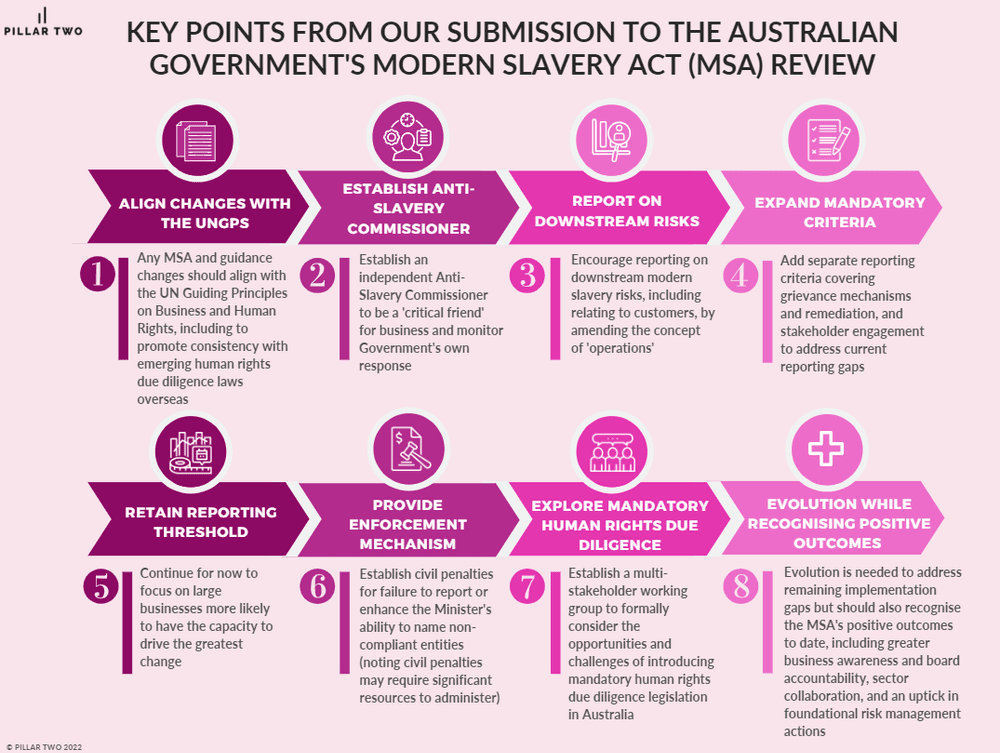 Photo: Modern Slavery Act, via images.squarespace-cdn.com
The development of the UK's approach to mandatory ESG reporting — drawing on international frameworks whilst adapting to domestic legislative priorities — places supply chain conduct at the centre of the disclosure agenda. Scope 3 emissions, supplier labour practices, and third-party environmental impact are no longer peripheral concerns for sustainability reports. They are becoming material disclosures with legal and reputational consequences.
Institutional investors, too, are applying increasing pressure. The major asset managers operating in the British market have made supply chain governance a standard element of their ESG engagement programmes. Organisations that cannot demonstrate coherent supply chain oversight — communicative as well as contractual — are finding that the conversation with their shareholders has become considerably more difficult.
What Strategic Supplier Communications Looks Like
The organisations beginning to address this gap are not, for the most part, doing so through elaborate programmes. The most effective interventions tend to be straightforward: a genuine extension of the organisation's communications culture into its supplier relationships.
This begins with orientation. Suppliers who understand the values, commitments, and reputation priorities of the organisations they serve are better positioned to conduct themselves in ways that support rather than undermine those priorities. This does not require extensive training programmes or costly engagement initiatives. It requires that the communications function has input into the information provided to new and existing suppliers — that onboarding processes include a genuine articulation of what the brand stands for, not merely what the contract requires.
Beyond orientation, the most forward-thinking British organisations are establishing regular communications touchpoints with their most significant supply chain partners. Not merely compliance reviews or procurement meetings, but exchanges that treat suppliers as stakeholders: organisations with their own perspectives, pressures, and communications needs, whose engagement with the brand relationship can be deepened through honest, two-way dialogue.
This is not a soft or sentimental proposition. Suppliers who feel genuinely engaged with the organisations they serve are more likely to raise concerns proactively, more likely to flag emerging issues before they become crises, and more likely to conduct themselves in ways consistent with the brand standards their customers have taken the trouble to communicate clearly.
The Transparency Imperative
There is a further dimension to this issue that British businesses are only beginning to grapple with: the public dimension of supply chain communications. Audiences — consumers, investors, journalists, and regulators alike — are increasingly interested not just in what organisations claim about their supply chains, but in the evidence that supports those claims. The era of unverifiable assurances is ending.
Organisations that have invested in genuine supplier communications relationships are considerably better positioned to provide that evidence. They can speak with authority about the values they have communicated to their partners, the standards they have established and explained, and the dialogue they have maintained. Those that have treated supplier relationships as purely contractual matters will find that when the question is asked — and it will be asked — they have very little to say.
Closing the Gap
The organisations that will navigate Britain's evolving supply chain accountability landscape most successfully are those that begin now to treat their suppliers as reputation stakeholders rather than contractual necessities. That means extending the communications function's remit into territory it has historically not occupied, building bridges between procurement and PR that currently do not exist, and accepting that the brand's reputation is shaped at every point in the chain that carries its name.
The reputational cost of continued silence in this space is no longer hypothetical. It is visible in the crisis communications budgets of organisations that discovered, too late, that their supply chain was not simply a commercial arrangement — it was a communications relationship they had neglected to begin.